I may have mentioned somewhere that I’ve been following @hardangerrebel on Instagram. It’s been a long time since I did any Hardanger, but I love watching her videos. Better yet, now she has started a blog and yesterday posted a gift pattern. I couldn’t resist …
I used what I had on hand … a piece of linen that had as open a weave as I could find, some Valdani variegated 12 perle cotton, and a Bohin 9 sharp … without a hoop. I’ve made a couple of counting errors, but it’s not too bad for a rusty old hand.
I also made some strawberry trifle, which is what my St Louis daughter most often requested for her birthdays. Not that Meliss is here to help us eat it, but I did send some over to her sister in Austin …
And our grandkiddos got to give out personalized Valentines yesterday. I put together some fortune tellers for the boys (thanks to Nancy for the inspiration) …
Parker and Ellis drew their own Valentines, which I copied for their classmates. Parker very thoughtfully decided to make two versions …
For the boys …and the girls
Last, but not least, Don and I are going out to dinner tonight … so we’re not done yet 💕
Nancy asked for a little more detail on how I worked the close/d herringbone to bind raw edged patches. I looked online and the best I could find was this video on plain herringbone https://yout-ube/RZdDyjtkPdo … and this one that shows herringbone as a filling stitch https://yout-ube.com/watch?v=zkNGRgk7u0g&si=EnSIkaIECMiOmarE which appears at the 2 minute mark. But neither show exactly how I do it.
So I looked in one of my books and found this diagram …
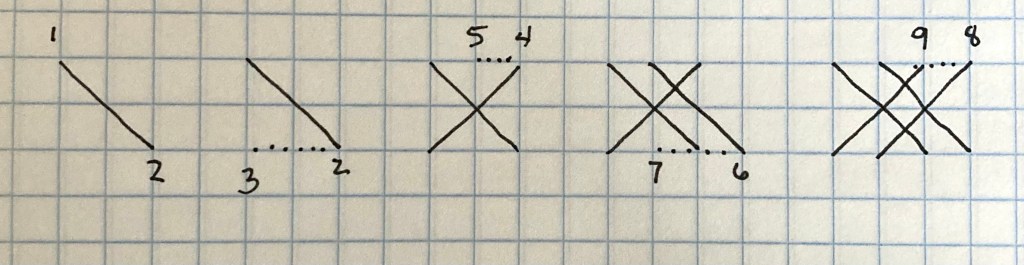
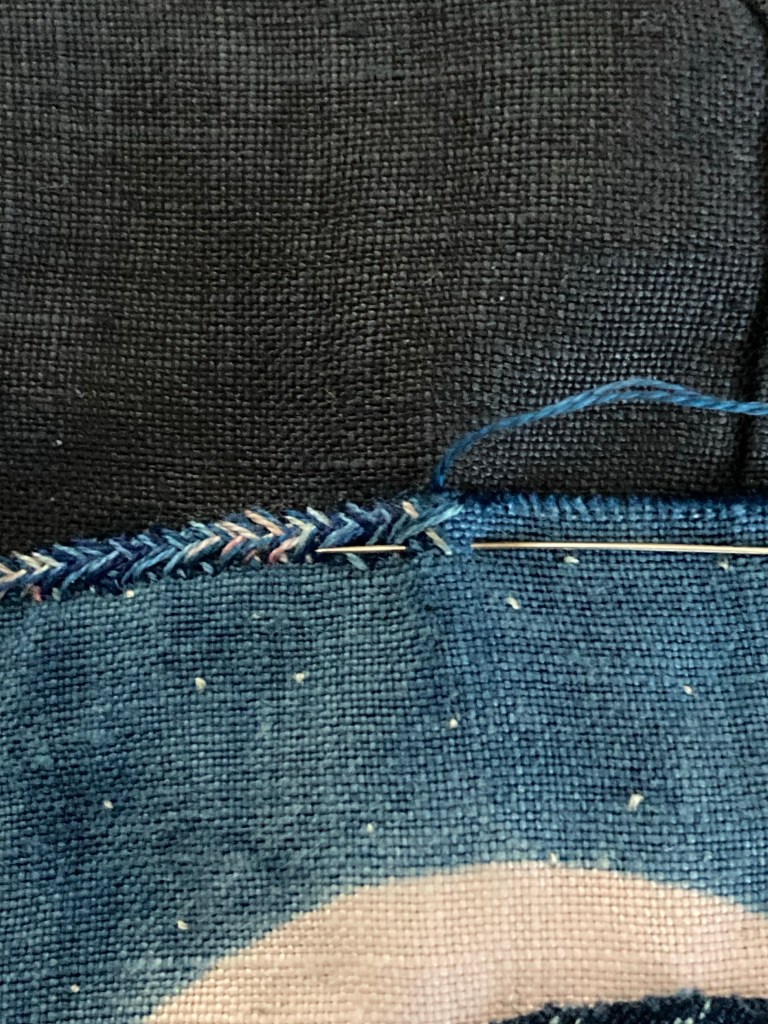
which was close, but not exactly it either. I like to make the stitches much closer together so that the raw edge is enclosed. So here’s my own stitch diagram, followed by pictures …
Start by making a simple cross stitch, where 1 is your needle coming up and 2 is the needle going down.
I don’t “stab stitch” and I don’t use a hoop … I just run the needle down at 2 and back up at 3 in one motion, like this …
Next I go down at 4 and come up at 5 …
Go down at 6 and come up at 7 …
Go down at 8 and come up at 9 …
and repeat repeat repeat …
What’s important to note is that I don’t do the stitches as precisely as they are diagrammed … I just go with the flow. The resulting line of stitches is very much like a backstitch, your needle moving from right to left while the stitches accumulate from left to right (with apologies to all the left-handers out there for whom everything is in reverse).
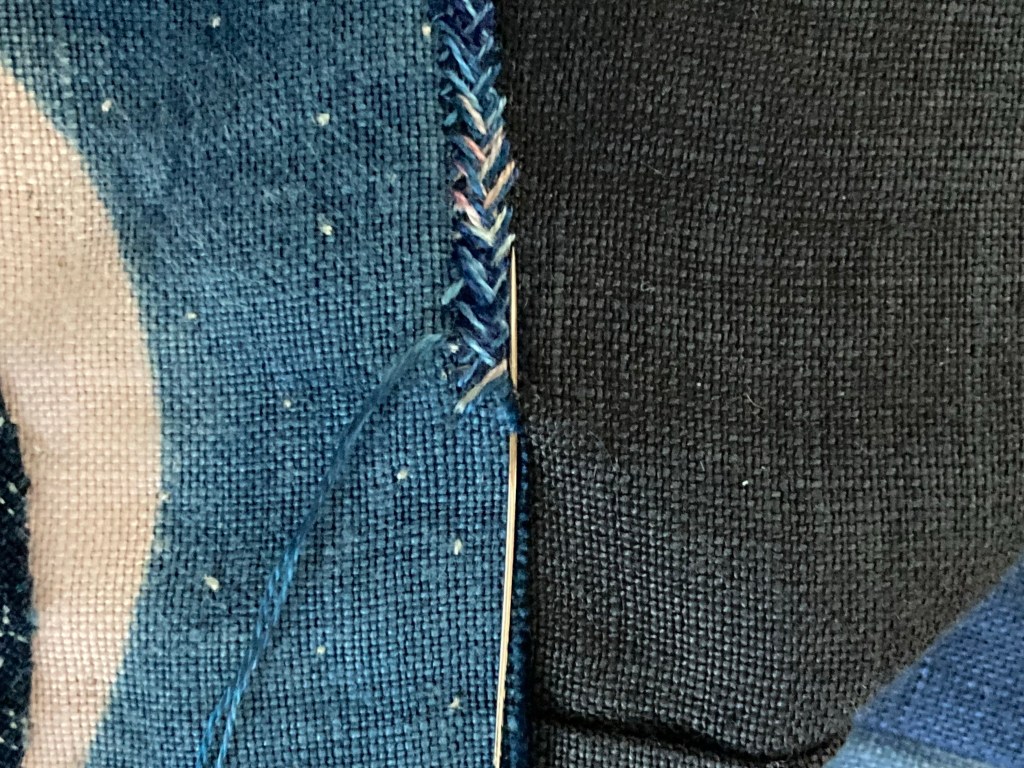
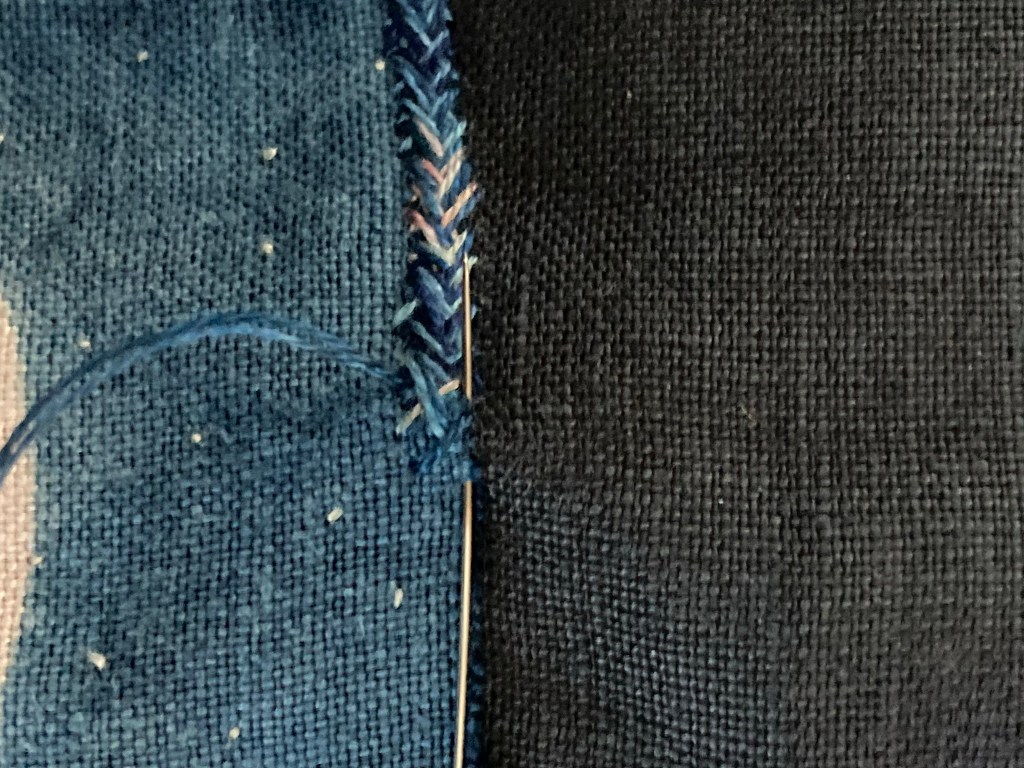
Unless, of course, I’m working vertically, which I sometimes do. In which case the needle is always pointing up while the stitches move down, sorta like this …
And yes, those are the same photos as before, just rotated 45 degrees to make the point that the stitching motion remains the same whether you work horizontally or vertically (I do both).
Phew … hope that helps. I do wish I had a set-up for doing video, which might have made things clearer, but I’m not ready for prime time 😉
On a lighter note, I had to laugh when I got an email from a local boutique showing the “latest” in denim fashion … looks like every pair of jeans I’ve owned for the past 50 years … with the exception of the holes in the knees, which I tend to patch, and the hems, which are usually just frayed at the heels …
Last for today, here’s an intriguing thing that I read about somewhere and then searched online …
It’s a subscription service (pricey at $33 a month) where you’re given a mechanized bin for discarding food waste (veggie and fruit trimmings, egg shells, food scraps, even chicken and fish bones). The device runs at night, dehydrating and crushing the food into a dry meal of sorts. There’s a charcoal filter to eliminate odors, which is recyclable and replaced periodically as part of the service. When the bin is full (every 3-4 weeks) you empty it into a resealable bag, box it up in a prepaid mailer, and give it to USPS to deliver to the mother ship. From there, the plan is to convert it to chicken feed … something they’re still “working on.”
You can read more about it here … and no, I’m not going to subscribe in advance, but for sure I’ll keep an eye out for news on how it works once it goes live.









 I'm Going to Texas (version 2.0)