
You have most likely noticed that my posts usually begin with a picture of where my stitching ended up. And here I pause to note that it’s challenging to take a selfie of one’s own foot.
Anyway, between power outages I watched a wonderfully well-done darning video on Instagram posted by @bookhou. Unlike others I have seen, this one was based on a form of blanket stitch. I love blanket stitch!
I had a pair of Don’s socks that already had holes in them and were just the right size to fit on my darning mushroom. With each iteration, I got better and better results …

First sock stitched over an existing hole 
Close-up of first mend 
Close-up of improved second mend over an existing hole
But I’m an utterly incapable of following recipes. So as I pondered some darned socks that had frayed over many washings …

I realized they were way too big to fit on my darning mushroom. I also had some serious reservations about cutting away the old darn in order to create the requisite hole.
So I figured, what if I stitched a darn right over the existing darn, then turned the sock inside out and cut away the problem area? I decided to try it and took still shots as I went …

My make-do darning base … 
stuffed into the sock 
Starting with running stitches from right to left … 
then carrying the yarn over from left to right 
Working rows of blanket stitch from right to left … 
followed by each new carrying thread … 
being careful all the while to not let the blanket stitches catch on the previously darned area underneath.

Completed darn seen right side out 
Turning the sock inside out and cutting into the old darn using Jude’s “pinch” method 
Continuing to cut away the old darn 
The final inside view: “layer-management” a la Jude Hill 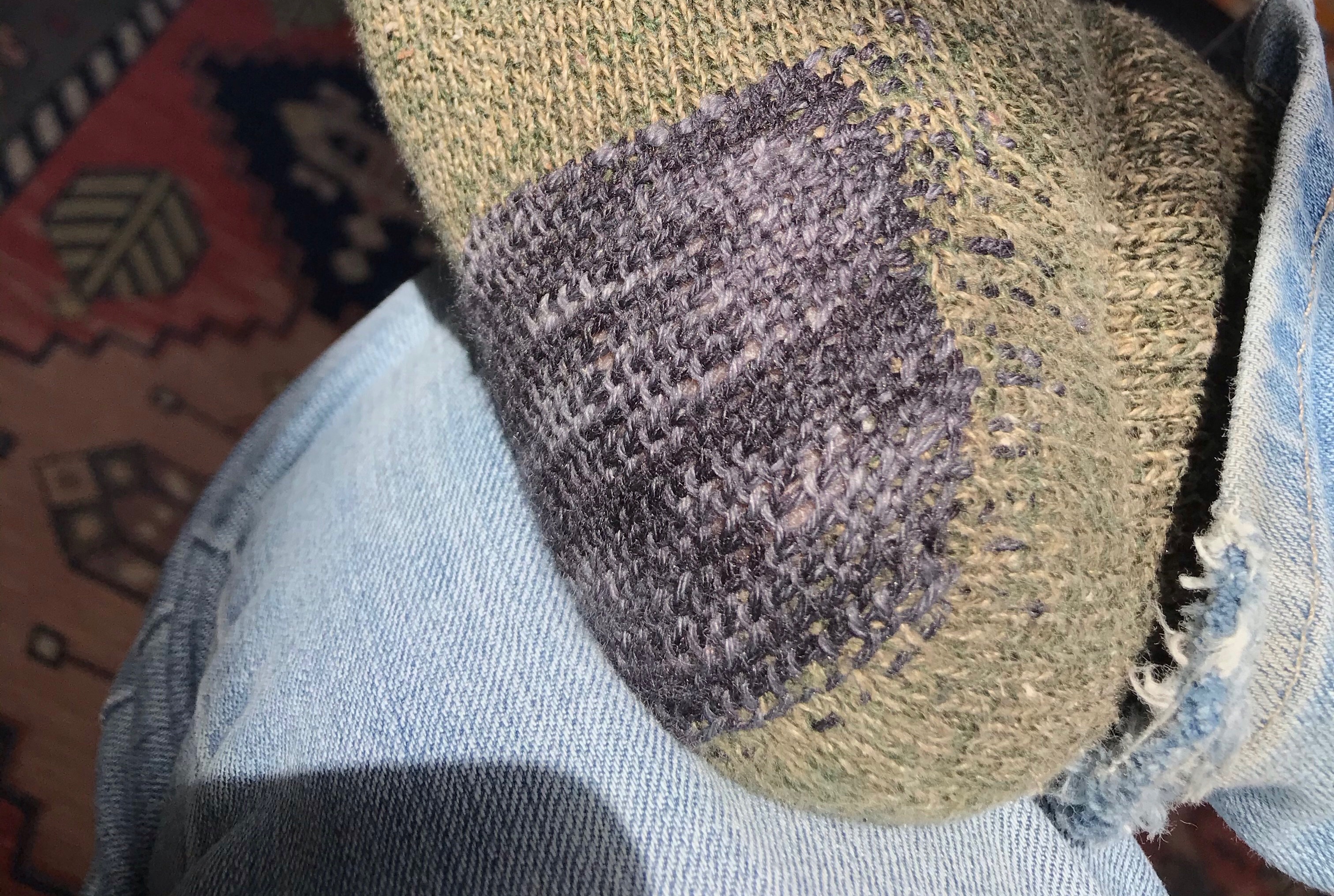
Yep, that feels pretty good!
The final test will be how they come out in the wash. But with the continued power outages and water restrictions in Texas, that trial will have to wait for another day.
In the meantime, I have lots more socks to do. Here’s the before …

and here’s the after …

P.S. Those beautiful variegated yarns are from Yarny Mammoth and Storied Fiber Art!
 I'm Going to Texas (version 2.0)
Gosh how I love to see your process & problem solving! Please do tell how they wash up. Stay warm 🙂
LikeLike
As you know, the blog is a memory holder in more ways than one … glad you’re enjoying the process. And the good news is our power is on more frequently today, so fingers crossed we’ll be through this soon.
LikeLike
love your sock mending, reminded me of Els and her beautifully stitched sock darningearly last year
http://fiberrainbow.blogspot.com/2020/02/darning.html
LikeLike
I remember that post … couldn’t imagine how I’d sort out the sock threads from the darning thread, but loved how it honored the original knitting
LikeLike
Brilliant and beautiful! Love the process shots so much and the steady hand snipping away is wonderful. Stay warm – we have been thinking of Texas in the snow and cold
LikeLike
I’ve been thinking how we went through much the same trouble with the power supply in February of 2011 … obviously our politicians didn’t do anything substantive to avoid a recurrence
LikeLike
Just think of what those socks have provided for us: Warmth, skin protection. Thanks for sharing each “step.” Your needlework just gets better and better, my Dear.
LikeLike
“sharing each step” … I love it!
LikeLike
LA – love the darning over the darning – that Don must be hard on socks!!!! Go well. B
LikeLike
I have to laugh … those are MY socks!
LikeLike
you should be selling those socks, they’re nice, pretty and could go into fashion, who knows. A whole in the market !!! A
LikeLike
I probably should have noted how long it took to mend each sock as the production costs would be prohibitive (ha!) … they are a labor of love (as in, both loving the wearer and loving the socks too much to give up on either one)
LikeLike